




Islamic New Year 2026 in Indonesia is more than just the first day of a new Hijri calendar. For many families, students, and workers, it is a moment to pause, remember the Prophet’s hijrah, and reset personal intentions for the year ahead, while also enjoying a national day off. If you live, study, or do business here, understanding what really happens on 1 Muharram helps you plan better and show respect in everyday interactions.
The date and public-holiday status of Islamic New Year are set through formal government decisions, so office schedules and school calendars follow clear rules. You can always cross-check the 2026 schedule through the official 2026 national holiday calendar issued for Indonesia, which lists Islamic New Year 1 Muharram 1448 H as one of the national holidays. This ensures that most government offices, banks, and many private companies close, giving space for religious and community events.
At the same time, Islamic New Year 2026 in Indonesia carries strong spiritual messaging. Leaders from the Ministry of Religious Affairs often remind Muslims that Hijri New Year is a call to move from harmful behaviour toward more honest, ethical living, and to strengthen social harmony across different faiths. Guidance like this is regularly shared in speeches and publications, such as messages from the minister about the deeper meaning of Islamic New Year and hijrah for modern Indonesian society, which you can see reflected in programs branded as “Peaceful Muharram.” Official statements on Islamic New Year’s spiritual meaning give useful context for how communities frame their local events. ✨
If you are a non-Muslim, an expat, or a traveler, it can be confusing to connect those national messages with what you actually see on the street: torchlight parades at night, packed mosques, charity events, or cultural festivals like Tabuik and Grebeg Suro. This guide links the national framework to local realities, so you know what is happening, why it matters, and how to move around respectfully. By the end, you will understand the meaning of Islamic New Year 2026 in Indonesia, the main Muharram traditions, and the practical impact on work, school, and travel, drawing on the way Indonesian authorities themselves describe the spirit of the Hijri New Year in official events and programs such as Peaceful Muharram initiatives. 🌙
Table of Contents
- Islamic New Year 2026 in Indonesia overview and meaning 🌙
- Islamic New Year 2026 in Indonesia as a national holiday 🕌
- Islamic New Year 2026 in Indonesi mosque and family rituals 🕯️
- Muharram traditions in Indonesia from Tabuik to Grebeg Suro 🎊
- How Islamic New Year 2026 in Indonesia shapes daily life 🧭
- Real Story — Experiencing Islamic New Year 2026 in Indonesia 📖
- Common mistakes about Islamic New Year 2026 in Indonesia ⚠️
- Future of Islamic New Year 2026 in Indonesia and outlook 🔍
- FAQ’s About Islamic New Year 2026 in Indonesia ❓
Islamic New Year 2026 in Indonesia overview and meaning 🌙
Islamic New Year 2026 in Indonesia marks the first day of Muharram 1448 H and the official start of the Hijri New Year. For Muslims, it recalls the Prophet Muhammad’s hijrah from Mecca to Medina, understood not only as a migration of place but a migration of mindset: leaving injustice, fear, and bad habits for a more ethical, community-focused life. That theme of transformation is repeated in sermons across the country.
In practice, this means Islamic New Year 2026 in Indonesia is framed as a time for muhasabah, or self-reflection. People are encouraged to review the past year, ask forgiveness for mistakes, and make concrete plans to improve relationships, finances, and spiritual discipline. Rather than loud fireworks, the mood is often calmer and more contemplative than the Gregorian New Year, with emphasis on prayer, learning, and charity.
Because Indonesia is the world’s largest Muslim-majority country, the Hijri New Year also plays a role in sustaining social harmony. Messages from religious leaders and local officials often highlight unity across ethnic and religious lines, reminding people to avoid hate speech and to strengthen neighbourly cooperation. In this way, Islamic New Year 2026 in Indonesia operates both as a religious observance and as a social “reset button” that encourages more responsible citizenship 🙂.
Islamic New Year 2026 in Indonesia as a national holiday 🕌
Islamic New Year 2026 in Indonesia is listed as a national public holiday, scheduled for Tuesday, 16 June 2026. On that day, schools and most government offices close, and many private businesses follow the official calendar. For employees and HR departments, this means the date must be treated like other national religious holidays when planning shifts, overtime, and annual leave.
Because Islamic New Year 2026 in Indonesia falls on a Tuesday, some companies may create long-weekend arrangements by combining it with collective leave or internal scheduling adjustments. Public transport usually still operates, but traffic patterns can change: residential areas may be busy at night with parades, while office districts may be quieter than usual. Travellers should factor this into airport transfers and intercity travel plans 🚐.
For schools and universities, the public holiday is often surrounded by educational activities. In the days before 1 Muharram, students might attend assemblies that review the hijrah story and its values, or prepare charity programs and poster competitions. Parents should expect homework or reflection tasks linked to Islamic New Year themes. For non-Muslim schools, the holiday still applies as national law, but the pedagogical focus may be more on cultural understanding and respect.
Islamic New Year 2026 in Indonesi mosque and family rituals 🕯️
At the heart of Islamic New Year 2026 in Indonesia are mosque-based and family-based rituals that give Muharram its spiritual colour. On the eve of 1 Muharram, many communities hold special dhikr (remembrance) and doa (supplication) gatherings in local mosques. Imams explain the meaning of Hijri New Year, read classical prayers associated with the transition between years, and invite worshippers to commit to better behaviour in the coming months.
Families also play a central role. Islamic New Year 2026 in Indonesia is often welcomed with small domestic rituals: gathering for a simple shared meal, reading stories of the hijrah with children, or reciting particular prayers together after Maghrib. In some areas, parents encourage their kids to write down personal goals for the new Hijri year—such as improving prayer discipline, saving money responsibly, or spending less time on unproductive online habits 😊.
Beyond the home, local organisations may run charity events to mark Muharram 1448 H, such as distributing food to orphans and the elderly. In some provinces, Qur’an recitation contests or public lectures are held at town halls or major mosques. These activities show how Islamic New Year 2026 in Indonesia combines individual worship, family bonding, and community service into one continuous flow of devotion.
Muharram traditions in Indonesia from Tabuik to Grebeg Suro 🎊
Islamic New Year 2026 in Indonesia also comes alive through colourful local Muharram customs that vary widely across the archipelago. In West Sumatra’s coastal city of Pariaman, the famous Tabuik festival marks the early days of Muharram with elaborate bamboo structures, drumming, and processions leading up to 10 Muharram. These processions blend local Minangkabau culture with historical Shia-influenced mourning rituals, yet today they also function as a major tourism attraction and symbol of communal identity.
In East Java, the name Grebeg Suro is widely known. In Ponorogo, Grebeg Suro involves parades, reog performances, and ceremonial processions that welcome the Hijri New Year while honouring local history and royal heritage. The event creates a blend of Islamic New Year 2026 in Indonesia with Javanese court traditions, showing how religion and culture intertwine rather than compete 🎭.
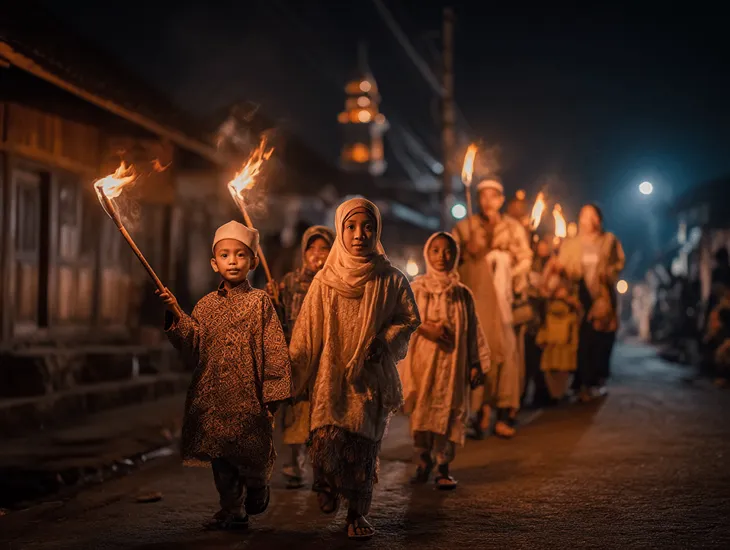
Other regions have their own variations. Some towns organise torchlight parades (pawai obor), where children and adults carry lanterns and chant praises as they walk around the neighbourhood after evening prayers. In Surakarta, there are traditions involving Kebo Bule, an albino buffalo considered symbolic in palace culture, which may be paraded to mark 1 Muharram. For visitors, these events can be striking, but it is important to remember they are not “shows” only for tourists; they are genuine expressions of local religious and cultural history. Respectful dress, modest behaviour, and listening more than performing are good principles to follow.
How Islamic New Year 2026 in Indonesia shapes daily life 🧭
Islamic New Year 2026 in Indonesia affects more than one day on the calendar; it shapes how people think about time, work, and life planning for the coming year. Many Muslims quietly map out intentions during Muharram, such as paying debts, strengthening family ties, or improving business ethics. For entrepreneurs and professionals, the Hijri New Year can be a natural checkpoint to review contracts, financial goals, and social responsibility projects alongside the Gregorian year.
For non-Muslims living in Indonesia, understanding Islamic New Year 2026 in Indonesia helps reduce friction in scheduling and communication. Knowing that 1 Muharram is a national holiday, and that the early days of Muharram may be filled with evening events, helps managers avoid late-night deadlines or early-morning meetings that clash with community activities. This awareness is especially important in mixed-faith workplaces, where colleagues will appreciate simple gestures like flexible hours or respectful greetings.
Daily life is also influenced at a neighbourhood level. During Muharram 1448 H, people may visit graves to pray for deceased relatives, contribute to charity funds, or support mosque renovation projects. Noise levels might shift, with more loudspeakers used for sermons in some areas, and more street activity at night. By paying attention to these rhythms, residents can plan rest, work, and travel more comfortably while remaining sensitive to the spiritual atmosphere 💡.
Real Story — Experiencing Islamic New Year 2026 in Indonesia 📖
Islamic New Year 2026 in Indonesia became unexpectedly meaningful for Daniel, a non-Muslim project manager from Europe based in Jakarta. He had seen Islamic dates on his office calendar, but mostly treated them like any other public holiday. When his team started talking about Muharram 1448 H and plans for 1 Muharram, he realised he did not fully understand what colleagues were preparing for—especially when they mentioned late-night mosque events and neighbourhood parades.
A week before Islamic New Year 2026 in Indonesia, his HR department shared a short briefing: the Tuesday would be a national holiday, some staff might attend dhikr and doa at mosques, and several were involved in charity drives for orphans. Daniel decided to ask respectful questions, and one colleague invited him to observe a local torchlight parade in South Jakarta. That evening, he watched families, children, and elders walking with lanterns, singing praises, and stopping by the mosque for short talks on the meaning of hijrah. There were no fireworks, only a calm but joyful atmosphere.
On the day itself, Daniel’s neighbourhood was quieter than a normal weekday, but community centres were busy. He visited a small food-distribution event, where volunteers handed out basic groceries to low-income families. Seeing how Islamic New Year 2026 in Indonesia combined spiritual reflection with social care changed how he saw the holiday; it was not simply “a day off”, but part of a continuous ethic of responsibility.
Back at work, Daniel used this experience to improve project planning. He adjusted timelines so the team would not be overloaded just before or right after 1 Muharram and encouraged colleagues to share personal goals for the new Hijri year, whether spiritual, financial, or educational. The result was a more open team culture, where Muslim and non-Muslim staff alike felt their rhythms were respected and understood. For Daniel, Islamic New Year 2026 in Indonesia became a case study in how learning local traditions can directly improve leadership and team cohesion 🙂.
Common mistakes about Islamic New Year 2026 in Indonesia ⚠️
Many people, including locals, make assumptions about Islamic New Year 2026 in Indonesia that can lead to confusion or tension. One common mistake is treating it as “just another New Year party” similar to 1 January, expecting fireworks, loud countdowns, and heavy nightlife. In reality, the tone is usually more spiritual and reflective. Excessive partying near mosques or during community religious events can be seen as disrespectful, even if it is legally allowed in some areas.
Another frequent misunderstanding is ignoring the public-holiday dimension of Islamic New Year 2026 in Indonesia. Employers or event organisers sometimes schedule important meetings, exams, or launches too close to 1 Muharram without considering that staff may be travelling home, attending mosque programs, or focusing on family. This can create unnecessary stress, especially for workers who feel torn between professional expectations and religious or cultural obligations.
A third mistake is assuming there is only one “correct” way to welcome Muharram. Indonesia’s diversity means that torchlight parades, Tabuik festivals, Grebeg Suro celebrations, or simple quiet prayers at home can all be valid Muharram customs in Indonesia. Criticising local variations without understanding their history can damage community relations. A better approach is to ask questions, learn the background, and focus on shared values like sincerity, charity, and moderation 🕊️.
Future of Islamic New Year 2026 in Indonesia and outlook 🔍
Islamic New Year 2026 in Indonesia is part of a broader trend where religious life is increasingly supported by digital tools and formal programs. Many mosques and institutions now stream Muharram lectures online, share doa texts through messaging apps, and promote charity campaigns via social media. This means that even people who cannot physically attend events can still take part in the spiritual atmosphere of 1 Muharram and the early days of the Hijri year.
Looking ahead, discussions about work-life balance, religious holidays, and social cohesion are likely to intensify. As urban life accelerates, Islamic New Year 2026 in Indonesia offers a natural yearly checkpoint where communities can re-evaluate local norms: noise levels, the role of youth in religious activities, and how to keep festivals inclusive yet respectful. Government agencies and religious organisations already use Muharram to emphasise anti-corruption messages, environmental awareness, and community solidarity, and this trend is expected to continue.
For travellers and expats, the outlook is positive as well. More structured information about public holidays, clearer guidance on etiquette, and the growth of responsible-tourism concepts around events like Grebeg Suro or Tabuik mean it will be easier to join celebrations respectfully. By treating Islamic New Year 2026 in Indonesia as both a spiritual milestone and a civic event, society can keep its deep religious roots while adapting confidently to modern realities 🌟.
FAQ’s About Islamic New Year 2026 in Indonesia ❓
-
When is Islamic New Year 2026 in Indonesia and is it a day off?
Islamic New Year 2026 in Indonesia falls on Tuesday, 16 June 2026 and is recognised as a national public holiday, so schools and most government offices are closed.
-
What is the main difference between Islamic New Year and 1 January in Indonesia?
Islamic New Year 2026 in Indonesia is centred on Muharram, hijrah, and self-reflection, with mosque events and charity programs, while 1 January is a secular calendar transition often marked by parties and fireworks.
-
Are there special obligations for Muslims on Islamic New Year in Indonesia?
There is no single mandatory ritual like Eid prayers, but Muslims are encouraged to pray, make dua, seek forgiveness, give charity, and renew intentions for the coming Hijri year.
-
What should non-Muslims or foreigners do during Islamic New Year 2026 in Indonesia?
Non-Muslims are welcome to continue normal activities while being mindful of local customs: dress modestly near mosques and parades, avoid loud parties next to religious events, and offer respectful greetings if appropriate.
-
Are all regions of Indonesia celebrating Islamic New Year in exactly the same way?
No. Islamic New Year 2026 in Indonesia is observed nationwide, but local traditions differ, from Tabuik in Pariaman to Grebeg Suro in Ponorogo and simpler torchlight parades or mosque gatherings in other regions.
-
Is it a good time to travel domestically during Islamic New Year 2026?
It can be, but travellers should expect possible changes in traffic patterns, bus and train schedules, and crowds in cities hosting major Muharram festivals. Booking transport and accommodation early is a smart move.


