




For many people, Eid al-Adha Indonesia looks like a day of prayer, cows, and meat packets, but beneath the surface it is a structured act of obedience to God and a national lesson in sharing. Muslims across the archipelago listen to sermons about Prophet Ibrahim’s willingness to sacrifice, while national guidance from the Ministry of Religious Affairs of the Republic of Indonesia helps unify the calendar and prayer schedule.
Beyond the mosque loudspeakers, Eid al-Adha 2026 in Indonesia is also a logistical challenge and a social opportunity. Mosque committees plan qurban lists, butchers, and distribution routes; urban families decide whether they will sacrifice individually or join a group cow; and village communities combine worship with long-standing local customs. National organizations like the National Zakat Board (BAZNAS) regularly remind the public that Eid al-Adha is not a luxury meat festival, but a serious channel of charity toward the poor.
At the same time, non-Muslim neighbors and foreign residents often feel unsure how to behave during Eid al-Adha Indonesia. Is it acceptable to watch the slaughter? Do offices close? How should apartment communities handle hygiene, animal welfare, and respectful photos or videos on social media? While official holiday decrees appear in the Government of Indonesia’s public information portal, day-to-day etiquette is learned in neighborhoods, offices, and schools.
This guide explains why Indonesia places so much importance on Eid al-Adha in 2026, what “sacrifice” really means beyond the slaughter, and how the holiday shapes everyday life. By the end, you will understand the religious foundations, the practical qurban process, the social impact of sharing meat, and how to participate or observe with respect—whether you are a Muslim, a non-Muslim neighbor, or a guest in the country.
Table of Contents
- Eid al-Adha Indonesia 2026: meaning, values, and public life 🕌
- Key Eid al-Adha Indonesia 2026 rituals and practical qurban rules 📜
- How Eid al-Adha Indonesia shapes prayer, community, and daily routines 🕋
- Eid al-Adha Indonesia traditions across regions and local cultures 🎎
- Why Eid al-Adha Indonesia links sacrifice, charity, and social justice ❤️
- Real Story — How Eid al-Adha Indonesia changed one family’s idea of sacrifice 📖
- Common Eid al-Adha Indonesia mistakes and how to honor the day better ⚠️
- Future of Eid al-Adha Indonesia 2026: environment, welfare, and digital systems 🔍
- FAQ’s About Eid al-Adha Indonesia ❓
Eid al-Adha Indonesia 2026: meaning, values, and public life 🕌
For a Muslim-majority nation, Eid al-Adha Indonesia is both a deeply spiritual moment and a major public holiday woven into the national calendar. At its core, the day commemorates Prophet Ibrahim’s willingness to sacrifice his beloved son purely out of obedience to God, before God replaced the child with an animal. Indonesian sermons emphasise that the real sacrifice is not the animal itself, but the believer’s readiness to give up ego, wealth, and comfort for a higher purpose.
In everyday language, Indonesians call this day Idul Adha or Hari Raya Kurban, and the word kurban points directly to the idea of drawing closer to God by offering something valuable. Families save money throughout the year to buy a cow, goat, or sheep that meets religious conditions, knowing that they will not personally eat most of the meat. Instead, the meat flows outward to those who rarely taste it, turning a personal act of worship into a visible sign of social solidarity.
On the civic side, Eid al-Adha Indonesia is a national public holiday, and offices, schools, and many businesses close or operate with limited hours. Streets near large mosques may close briefly for the Eid prayer, while local governments coordinate animal health checks and waste management. This combination of religious devotion and public administration shows how seriously the country treats the holiday: as a time when worship, community care, and orderly public life must work together harmoniously 😊.
Key Eid al-Adha Indonesia 2026 rituals and practical qurban rules 📜
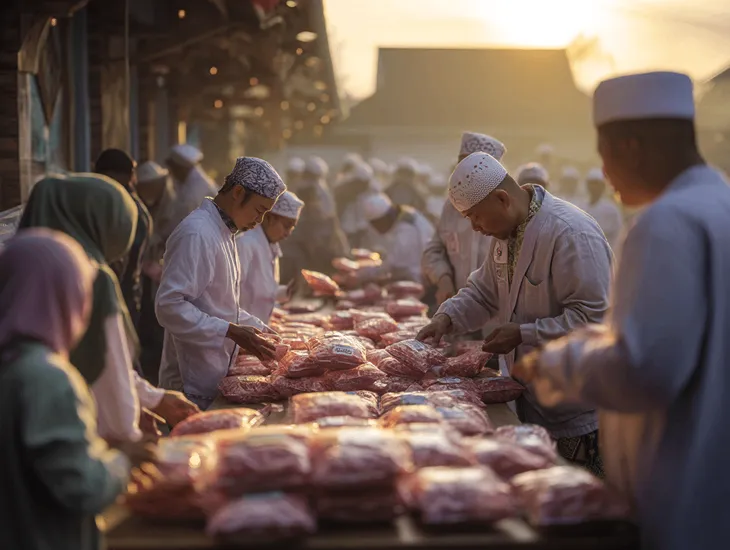
When people talk about Eid al-Adha Indonesia traditions, they often imagine the moment of slaughter, but the ritual actually has several structured steps. After the early morning Eid prayer and sermon, communities that are ready for qurban move to designated slaughter locations, often within mosque grounds or nearby fields. Organisers check lists of donors, match each donor or group to an animal, and ensure that the person offering sacrifice at least witnesses the process or has it conducted clearly on their behalf.
There are practical rules that guide Eid al-Adha sacrifice rules Indonesia. Animals must be healthy, of a minimum age, and free from obvious defects. A cow or camel is usually shared by up to seven people, while a goat or sheep is normally offered by one person or one household. The person performing the slaughter is expected to be Muslim, competent, and gentle: sharpening the knife away from the animal, avoiding unnecessary pain, and reciting the proper intention and phrases during the act 🐄.
After slaughter, meat is divided into portions: one part may be kept by the owner, one shared with relatives and friends, and a significant portion reserved for the poor. In practice, many Indonesians choose to give almost everything away, especially in communities where meat is a rare luxury. Committees prepare plastic bags or reusable containers, record names to avoid duplication, and coordinate deliveries to houses, settlement areas, and community centres. When done carefully, the ritual becomes a well-managed flow of protein from those who can afford sacrifice to those who generally cannot.
How Eid al-Adha Indonesia shapes prayer, community, and daily routines 🕋
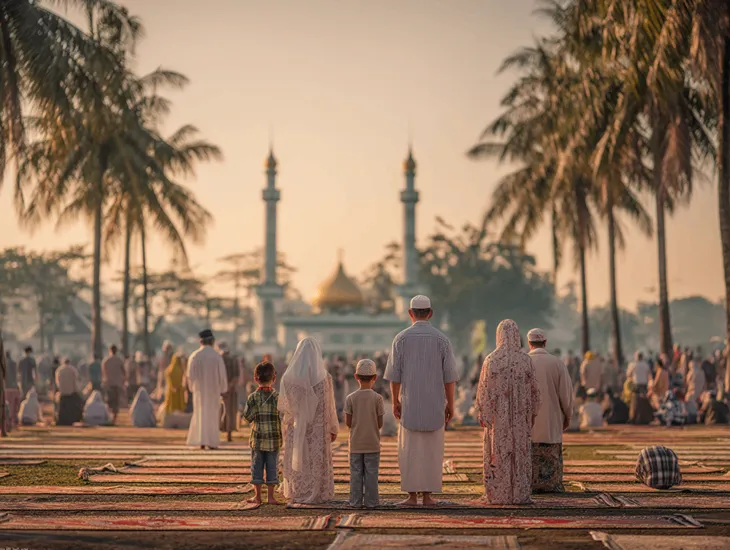
On the spiritual side, Eid al-Adha Indonesia begins with the takbir echoing from mosques before dawn. Families dress modestly in clean clothes, often in matching outfits, and gather for the Eid prayer either inside mosques or on large open fields. The sermon explains the meaning of sacrifice, patience, and trust in God, and many preachers highlight everyday forms of sacrifice such as raising children honestly, working ethically, and staying away from corruption.
For ordinary citizens, Eid al-Adha 2026 in Indonesia reshapes the rhythm of a typical day. Offices and schools are closed, and many people travel back to their hometowns if the holiday falls near a weekend or joint leave days. In urban neighbourhoods, residents coordinate parking, animal holding areas, and slaughter timing so traffic is not completely blocked. Children are curious and often enthusiastic, but parents decide carefully how much of the slaughter process is appropriate for them to witness directly.
Non-Muslim neighbors and foreign residents are a visible part of this rhythm. Some choose to stay indoors during the slaughter, others observe from a distance to learn about the culture, and many receive packaged meat as a gesture of friendship. Respectful behaviour means avoiding insensitive photos or videos, not mocking the ritual online, and understanding that for many Indonesians Eid al-Adha Indonesia is a once-a-year chance to show devotion through real, material sacrifice 🙏.
Eid al-Adha Indonesia traditions across regions and local cultures 🎎
Although the religious core is the same everywhere, Eid al-Adha Indonesia traditions vary across islands and ethnic groups. In some Javanese cities, the day is combined with processions, gamelan performances, or symbolic offerings that reflect older local customs alongside Islamic practice. In parts of Sumatra and Sulawesi, long-distance family visits and extended community meals turn the day into a reunion that stretches well beyond the prayer and qurban ritual.
In rural areas, animals for Eid al-Adha Indonesia may be raised for months by local farmers who view qurban season as a crucial part of their annual income. Negotiations happen in village markets, and animals are sometimes decorated lightly before being led to the slaughter site. In more urban settings, animals arrive by truck or are ordered through online platforms, with delivery timed close to the day to reduce stress on both residents and livestock 🐐.
Local culture also shapes how meat is cooked and shared. Some regions prepare spicy stews, while others focus on grilled dishes or traditional soups using bones and offal so that almost every part of the animal is used. The shared meals that follow remind people that Eid al-Adha Indonesia is not only about giving but also about sitting together, eating together, and reconnecting with relatives, neighbors, and even people they rarely meet at other times of the year.
Why Eid al-Adha Indonesia links sacrifice, charity, and social justice ❤️
From a faith perspective, Eid al-Adha Indonesia teaches that true sacrifice is measured not by how expensive the animal is, but by the sincerity behind it. However, Indonesian scholars and community leaders increasingly emphasise the social dimension: if the day ends with the same families enjoying meat while the poor remain hungry, something has gone wrong in the implementation of Hari Raya Kurban. The ritual is designed so that a large share of the meat should leave the donor’s home and reach those who rarely eat it.
This is where charity and social justice intersect. When qurban is organised thoughtfully, Eid al-Adha sacrifice rules Indonesia encourage donors to think beyond their immediate circle. Committees identify households that seldom receive meat, informal workers, street vendors, and residents of simple rental rooms. Some urban mosques partner with remote villages or disaster-affected areas, sending part of their qurban meat to communities that need it more than the donors themselves ❤️.
At the same time, Eid al-Adha challenges everyday habits. People are reminded not to show off on social media with dramatic slaughter images or extravagant displays, because humility is a central component of the Islamic holiday of sacrifice. Instead, they are encouraged to reflect on what they are willing to give up—extra consumption, time, or comfort—to make room for others’ wellbeing. In this way, Eid al-Adha Indonesia becomes an annual training ground for empathy, fairness, and responsible use of wealth.
Real Story — How Eid al-Adha Indonesia changed one family’s idea of sacrifice 📖
In 2026, a family in Bandung had a turning point in how they understood Eid al-Adha Indonesia. Andi and Sari both worked in the city, and for several years they had simply transferred money to a mosque committee, trusting that qurban would be taken care of. They rarely visited the slaughter site and mostly focused on cooking the portion of meat that returned to their kitchen. For them, Idul Adha felt important but distant—a box ticked through an online transfer.
That year, their teenage daughter asked why they sacrificed an animal every year, and who really benefitted from it. Realising they could not answer clearly, the parents decided to join the process actively. They met the committee, saw how animals were selected, and helped prepare name lists for meat distribution in nearby densely populated rental blocks. When Eid al-Adha Indonesia arrived, they attended the sermon, stood at a respectful distance from the slaughter area, and later helped carry meat parcels to homes they had never visited before.
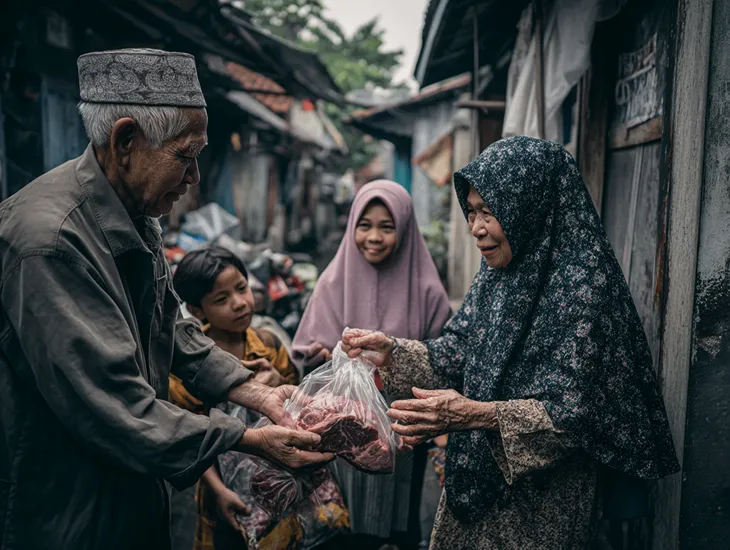
In one narrow alley, they delivered meat to an elderly couple who quietly admitted that Eid was the only time they ate beef all year. The visit was brief, but it stayed with Andi and Sari long after the holiday. They realised that the real sacrifice was not the quick pain of the animal, but their willingness to step out of comfort, meet strangers, and confront the unequal way food is normally distributed.
From then on, Eid al-Adha Indonesia changed meaning for the family. They still transfer money, but they also volunteer time and attention. Their daughter now sees Hari Raya Kurban not just as a ritual her parents pay for, but as a living lesson in humility, social responsibility, and the power of coordinated charity within a community 📖.
Common Eid al-Adha Indonesia mistakes and how to honor the day better ⚠️
Despite good intentions, communities sometimes make mistakes that weaken the spirit of Eid al-Adha Indonesia. One common error is focusing on how “big” the animal looks for social prestige, instead of ensuring it is healthy and properly handled. This can lead to stressful transport, overcrowded holding areas, or poor slaughter techniques that are neither kind to the animal nor safe for humans.
Another issue arises when committees underestimate the importance of hygiene and organisation. Without clear planning, waste from Eid al-Adha Indonesia traditions can block drains, attract pests, or disturb neighbors with smell. Lacking gloves, clean knives, and proper surfaces, volunteers may face health risks. Good practice means planning water sources, waste disposal points, and simple protective equipment in advance, treating the whole operation as both an act of worship and a public health responsibility 🧼.
A third mistake is uneven distribution. If meat stays mostly within the donor circle or is stored excessively in freezers, the intended social justice impact is reduced. To honor the day better, committees can map out priority recipients, prepare clear schedules, and avoid turning distribution into a chaotic first-come, first-served scramble. When planning is careful and intentions are humble, Eid al-Adha Indonesia becomes more than a yearly habit—it becomes a highly effective tool for reducing temporary food insecurity and strengthening trust between the better-off and the vulnerable.
Future of Eid al-Adha Indonesia 2026: environment, welfare, and digital systems 🔍
Looking ahead, Eid al-Adha Indonesia is likely to evolve alongside growing awareness of environmental impact and animal welfare. Large numbers of animals in urban areas mean more waste and higher demand for water and temporary space. Some city governments and mosques are already experimenting with composting systems, designated slaughterhouses, and stricter animal health checks to reduce disease risk and environmental strain.
Digital tools are also changing how Eid al-Adha Indonesia traditions are managed. Many mosques and charities now accept qurban payments via apps, issue electronic receipts, and share reports on how many animals were slaughtered and where the meat went. This transparency builds trust, especially for donors who live far from the slaughter location or contribute to national-scale programs that send meat to remote regions 📱.
At the same time, there is a stronger public conversation about balancing efficiency with the personal, spiritual side of the Islamic holiday of sacrifice. While technology can simplify payments and distribution, scholars and community leaders remind Muslims not to let automation replace reflection. The challenge for 2026 and beyond is to keep Eid al-Adha Indonesia grounded in sincere worship and real human connection, while adopting better environmental practices, welfare standards, and data-driven management to protect both people and animals.
FAQ’s About Eid al-Adha Indonesia ❓
-
What is the main purpose of Eid al-Adha Indonesia?
The main purpose is to remember Prophet Ibrahim’s willingness to sacrifice in obedience to God and to express that obedience today through prayer, sacrifice of animals, and sharing meat with those in need.
-
How is Eid al-Adha Indonesia different from Eid al-Fitr?
Eid al-Fitr celebrates the end of Ramadan and focuses on completing the month of fasting, while Eid al-Adha Indonesia is tied to the Hajj period and centers on sacrifice, charity, and the story of Prophet Ibrahim.
-
Who is allowed to perform qurban during Eid al-Adha Indonesia?
Muslims who are financially able and free from certain debts are encouraged to perform qurban, either individually or by sharing in a cow or similar animal. Those who cannot afford it are not blamed and may instead receive meat.
-
Can non-Muslims receive meat from Eid al-Adha Indonesia qurban?
Yes, in many communities non-Muslim neighbors and friends receive meat as a gesture of goodwill, especially in mixed neighborhoods, as long as local customs and sensitivities are respected.
-
How should children be introduced to Eid al-Adha Indonesia rituals?
Parents can explain the story and meaning in age-appropriate language, let children join the prayer, and decide carefully how much of the slaughter process they should see. The goal is to teach compassion, not to create fear.
-
Is it mandatory to attend the slaughter site during Eid al-Adha Indonesia?
No, it is not mandatory, but it is recommended that donors at least understand how their qurban is being carried out and trust that the committee is following proper religious and ethical guidelines.


