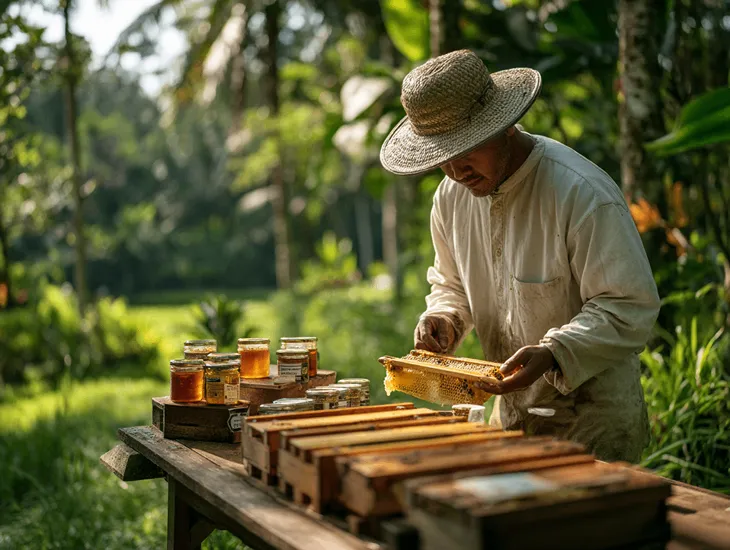


Bali honey investment looks small compared to villas or hotels, yet it sits in a rising niche. Demand for functional foods and natural sweeteners is growing, while stingless bee honey adds a premium story and price.
Indonesia regulates agriculture and food systems through the Ministry of Agriculture of the Republic of Indonesia. For Bali honey investment, that means playing within clear quality, safety, and land-use rules.
Honey production statistics and rural surveys from BPS – Statistics Indonesia show thousands of households involved in honey and non-timber forest products. That indicates a wide base of skills and raw supply to work with.
In Bali, trigona and forest honey already appear in wellness resorts, agro-tours, and specialty shops. Bali honey investment plugs into existing tourism flows while supporting farmers, forest guardians, and local SMEs.
Foreign investors often only see villas, beach clubs, and restaurants. Bali honey investment offers another layer: scalable micro-farms, bee adoption programs, and branded products that can travel far beyond the island.
Global agencies like FAO Indonesia – food and agriculture insights stress sustainable, diversified agriculture. Bali honey investment fits that agenda, blending profit with biodiversity, community jobs, and long-term resilience.
Table of Contents
- Why Bali Honey Investment Is a Hidden Agricultural Gem
- Building a Legal Structure for Long-Term Bali Honey Investment
- Supply, Quality and Brand Strategy Behind Bali Honey Investment
- Operational Partners for Scaling Your Bali Honey Investment
- Real Story — How One Bali Honey Investment Beat the Odds
- Returns, Risk and Exit Paths in Serious Bali Honey Investment
- ESG Impact and Community Benefits of Bali Honey Investment
- Action Plan Checklist to Launch Your Bali Honey Investment
- FAQ’s About Bali honey investment ❓
Why Bali Honey Investment Is a Hidden Agricultural Gem
Bali honey investment taps into three trends at once: health-conscious consumers, regenerative agriculture, and experience-driven tourism. Rather than bet on a single big project, you can build diversified micro-assets.
Unlike large plantations, hive networks can grow gradually. Bali honey investment lets you test markets, refine branding, and scale capacity step by step, without committing to huge upfront land or construction costs.
At the same time, stingless bee honey and forest honey help pollinate crops and support biodiversity. That means Bali honey investment can create returns while strengthening local food systems instead of exhausting them.
Building a Legal Structure for Long-Term Bali Honey Investment
Bali honey investment usually needs a clear vehicle, often a PT PMA or partnership with an existing local company. The choice affects control, capital requirements, and how profits are distributed or reinvested.
Never hide behind informal nominee deals. A transparent Bali honey investment structure should show who funds the business, who manages operations, and how land or hive sites are secured, whether by lease, cooperation, or concessions.
Consider where processing and packaging occur. If your Bali honey investment includes a small facility, you may trigger extra food safety, labour, and environmental rules. Build them into your licensing roadmap from the beginning.
Supply, Quality and Brand Strategy Behind Bali Honey Investment
Bali honey investment succeeds or fails on consistent supply and quality. That means mapping nectar sources, seasons, and farmer partners, not just assuming “bees will find flowers” all year round.
Work with trained beekeepers and extension programs so harvesting protects colonies. Over-harvesting damages long-term yields. A serious Bali honey investment includes training, fair pricing, and simple quality protocols for every hive.
Branding must distinguish your jars from generic honey. Emphasise origin, floral sources, stingless bee benefits, and testing or certifications. Done well, Bali honey investment turns each bottle into a small, export-ready story.
Operational Partners for Scaling Your Bali Honey Investment
Bali honey investment is rarely a solo show. You need local coordinators, farmer groups, and possibly tourism partners who host hive visits or tasting sessions for guests.
Clarify roles early. A Bali honey investment can pay farmers per litre, per hive, or through revenue shares. Whatever model you pick, write it down and keep records so expectations stay aligned during good and bad seasons.
As scale grows, you may add logistics, e-commerce, or export partners. A resilient Bali honey investment spreads operational risk, so one bottleneck in shipping or tourism does not shut down the entire value chain.
Real Story — How One Bali Honey Investment Beat the Odds
Bali honey investment once attracted a wellness-focused investor who wanted “something green” beyond villas. She started by backing twenty trigona hives in a village known for coffee and spices.
The first year was messy. Yields were irregular, labels inconsistent, and a promised hotel deal fell through. Her Bali honey investment seemed too small to matter and too complex to manage from abroad.
Instead of quitting, she funded training, basic quality gear, and a rebrand. Within two years, the Bali honey investment supplied resorts, an online shop, and gift boxes. Modest but steady profits arrived, along with strong village loyalty.
Returns, Risk and Exit Paths in Serious Bali Honey Investment
Bali honey investment can be profitable, but it is not a get-rich-quick scheme. Returns depend on hive productivity, market prices, marketing, and how well you manage disease, climate, and land access.
Model conservative scenarios first. A responsible Bali honey investment assumes slower ramp-up, occasional colony losses, and evolving regulations, then sees any upside as bonus rather than entitlement.
Think about exit from day one. A mature Bali honey investment might be sold to a local partner, a larger F&B group, or converted into an employee-owned cooperative, with you retaining brand or royalty agreements.
ESG Impact and Community Benefits of Bali Honey Investment
Bali honey investment can score highly on ESG metrics when designed well. It protects pollinators, supports agroforestry, and provides non-seasonal income to farmers and forest communities.
Work with villages to align hives with local land-use plans and customs. A respectful Bali honey investment listens to community priorities, from water use to sacred trees, before placing boxes or building structures.
Transparent revenue sharing and local hiring enhance social impact. When communities see clear benefits, Bali honey investment becomes easier to defend against policy shifts, competition, or social media scrutiny.
Action Plan Checklist to Launch Your Bali Honey Investment
Start your Bali honey investment by defining goals: income, impact, branding, or a mix. Decide how much capital you can commit for at least three to five years without needing rapid withdrawal.
Next, map legal structure, land or hive locations, and partners. Build a simple timeline that covers licensing, training, pilot production, packaging, and first sales. Each stage should have clear decision gates.
Finally, document systems for quality, finance, and reporting. A disciplined Bali honey investment, even at small scale, uses basic dashboards and regular reviews so emotion and hype never replace evidence.
FAQ’s About Bali honey investment ❓
-
Is Bali honey investment suitable for small foreign investors?
Yes, Bali honey investment can start small with limited hives, as long as you use proper structures, contracts, and realistic return expectations.
-
What makes stingless bee Bali honey investment attractive?
Stingless bee honey carries a premium image as a functional food. Combined with Bali’s brand, this can support higher margins than commodity honey.
-
How risky is Bali honey investment compared to villas?
It carries agricultural and market risk but often needs less capital than property. Diversification across sites and partners reduces volatility.
-
Can Bali honey investment include agro-tourism?
Yes, you can link farm visits, tastings, or workshops with existing hotels or tours. Just ensure safety, permits, and fair revenue sharing with hosts.
-
How long before a Bali honey investment becomes profitable?
Timelines vary, but two to four years is a common planning window. Conservative projections and phased scaling help protect your capital.